top of page

It was back in 2012 in its Living Planet Report when the World Wildlife Fund asserted that, if the Western developed nations continued with their pattern of consumption, we would need three planet’s worth of resources by 2050. During the years since then, consumerism and population have expanded across regions like Africa and parts of Asia, with supposedly sustainable activities such as sourcing the minerals required for electrical vehicles steadily scarring once pristine landscapes.


Meanwhile, the extra 1.1 billion people added to the population over that time not only have to be fed but also accommodated which means the need to access sufficient environmentally-friendly, and ideally carbon negative, building materials has become just as important a goal as maximising the cultivation of drought resistant plants. Undoubtedly, the UK is by no means the only country where housebuilding is failing to keep up with the crisis in demand.  


MMC solutions require material advancements


The past quarter century has seen significant increases in the use of Offsite technology or Modern Methods of Construction (MMC), with engineered timber being the most popular primary material across the sector in most of Europe; with producers of competing materials also embracing sustainability goals. 


Aerial view of a large yellow crane near wooden houses under construction, surrounded by trees and fields, with scattered building materials.

Carbon negative materials are defined as those which sequester more carbon than they emit during their life cycle with other examples including hempcrete and recycled steel, aluminium or concrete.  All of them, though particularly the trio of metals, constitute a precarious balance involving embodied energy, the depletion of natural resources and the time required for their replacement.  Significantly, however, the formation of ores and other mineral deposits are defined by geological epochs rather decades. 


As an increasingly important and costly factor, the amount of energy which goes into producing common building materials is well understood, with recycled steel requiring 74% less energy for its manufacture than the virgin product, a figure which rises to 95% for recycled aluminium which is popular for secondary structural elements like curtain walling.


Recycled steel is also now being utilised for a minor proportion of the rebar required to take the tensile forces within reinforced concrete, while recycled aggregates and waste products, like pulverised fuel ash and ground granulated blast furnace slag, are routinely specified to offset the use of energy intense cement. Ironically though, the supply of PFA and GGBS is rapidly reducing as coal-fired power plants and steel foundries are razed to the ground in the fight to counter Climate Change, making the construction industry’s quest for “ConcreteZero” ever more difficult. 


The harsh reality, then, is that the heavyside construction methodologies which shaped so much of the infrastructure which surrounds us is desperately scrabbling to reach the level of sustainability which for timber can quite literally come naturally.  This fact does not, of course, mean that timber-based building systems are automatically virtuous, and due diligence has to be employed to ensure that their specification will be good for the planet.  


As the recent COP 30 in Brazil reminded us, forests are the lungs of the Earth, a resource we squander at our peril which is why chain of custody and whole life strategies for the use of wood are crucial. Indeed, the need for constant vigilance was highlighted last year by the organisation Earthsight when it produced the video entitled “Blood stained Birch” which exposed how since the start of the war in Ukraine, more than €1 billion of Russian plywood has been wrongly given FSC- accreditation by China and sold into Europe. 


Once fully implemented, the European Union’s Deforestation Regulation (EUDR) will offer a substantial bulwark against illegal and unsustainable cropping of timber, but responsible manufacturers have already made significant strides to ensure their own operations are as well managed and transparent as possible.


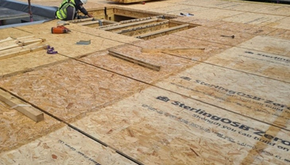
With a high proportion of the company’s supplies of raw materials coming from properly-managed forests within the British Isles, and huge investment having been made in areas like production, transport and cutting waste, coupled with the use of biomass for the drying processes and a policy of only buying power from guaranteed renewable sources, the entire product range of West Fraser in the UK has now achieved Carbon Negative status.


This ensures its own customer network can be assured that the panel products they are using to produce structural insulated panels (SIPs) and other offsite systems like floor cassettes, as well as for sheathing, decking and other applications, all fully meet the spirit as well as the regulations which will expand the use of carbon negative building materials.

As the annual SterlingOSB Zero/RIBAJ competition celebrated its 10th anniversary, the 2025 competition entitled Powers of Ten, challenged architects to explore the principles of scale. Entrants were unrestricted by building standards and were free to play with the concept of scale and design a structure from competition sponsor West Fraser's SterlingOSB Zero.


Three people stand smiling; one holds an award. A screen behind them reads "Monolithic Playhouse." They're in a modern setting with plants.
Pictured are architects Olivia Dolan and Sem van der Straaten, with West Fraser's marketing manager, David Connacher

This year's commended winners, Olivia Dolan and Sem van der Straaten, designed their Monolithic Playhouse; a set of eight wooden monoliths linked together with SterlingOSB Zero to create one unified structure. Here Olivia and Sem explain the inspiration behind their entry and what they like about SterlingOSB Zero.


Q. What inspired your design for the competition?

When we were looking into the ideas of scale originally, we wanted to do something that was big. The we reconsidered and thought we'll do something that was small. We wanted to play on the idea of something that you would initially see as being like a monolithic object, like a cathedral or a church.


We would then try and scale that down to see how you could interpret it in different ways. We decided to have eight different categories of elements, and we wanted to have a very playful scene where people could crawl under or come on top of them. We put all these elements together to produce a versatile play stage; that was the concept idea.


Q. As architects, what do you like about SterlingOSB Zero?

The benefit of OSB is that you can use it outside as it is durable; it opens up more possibilities for design.


For further information, call 01786 812 921 or visit https://uk.westfraser.com

As the annual SterlingOSB Zero/RIBAJ competition celebrated its 10th anniversary, the 2025 competition entitled Powers of Ten, challenged architects to explore the principles of scale. Entrants were unrestricted by building standards and were free to play with the concept of scale and design a structure from competition sponsor West Fraser's SterlingOSB Zero.


Two men shaking hands, one holding a triangular award. They're in a room with a screen and plants, both smiling, dressed in blue and black.
  Pictured is West Fraser's marketing manager, David Connacher, and Steve McCloy

This year's commended winners, Steve McCloy and C J Lim of McCloy + Muchemwa Architects, created a giant picnic table complete with deckchairs, cakes, and teapots as a memorial for the late Queen Elizabeth II and Prince Philip. The architects imagined the children's play structure as a permanent fixture in the grounds of Buckingham Palace. Here Steve McCloy talks about the commended winning entry and what SterlingOSB Zero provides architects.


Q. What inspired your design for the competition?


Our design was inspired by children's books and literature. We looked at the way that, in stories such as Alice in Wonderland, the change of scale is the moment where the child enters a new world of imagination. We find, as architects, that shift of perception or that imaginative leap is most inspiring for our work. So, whether we're designing a house or a public building or an installation, imagination is the most important point.


Q. What do you like about SterlingOSB Zero?


Something that we've noticed that is really important compared to other materials like plywood, is that OSB is extremely durable and resilient for outdoor installations, public artworks, and temporary purposes, so it's been really useful for us, doing budget projects.


For further information, call 01786 812 921 or visit https://uk.westfraser.com

bottom of page