top of page

FP McCann’s architectural facade division has supplied and installed bespoke acid-etched precast concrete cladding units, stone inlaid precast panels and precast balconies to envelope a brand-new 190,000 sqft luxury residential development overlooking Hyde Park, London. “Park Modern” is a nine-storey building comprising 57 high-end one to six bedroom apartments, amongst some of the most prestigious in Kensington. Residents in the development have access to valet parking, a resident’s lounge, a 25-metre pool, gym, spa, cinema, and treatment salon.


Modern curved apartment building on a city street corner. People walk nearby. Clear sky with trees and buildings in the background.

Completed earlier this year, the super-prime £500 million design and build project for client Fenton Whelan, was awarded to central London based construction company Ant Yapi UK Ltd. Unique to Park Modern’s design is an undulating precast concrete sandstone look façade and curved precast balconies working in combination with complementary smooth natural stone slips inlaid in precast cladding panels.


Designer PLP Architecture inspired by the surrounding parkland, used the setting to create natural lines to allow the building to sit comfortably within the Hyde Park landscape. Recognising FP McCann’s experience in this field, Ant Yapi UK along with PLP Architecture approached the Company to quote for the design, supply and installation of the three key precast concrete architectural elements. 


Modern building facade with curved balconies, light stone exterior, and glass windows. Black metal railings add contrast. Blue sky above.

On securing the contract FP McCann employed structural installation partner RLH Construction Ltd to undertake the panel façade build using free issued tower cranes, significantly reducing the need for any scaffolding on the building. The balconies delivered on a supply only basis, were fitted by building frame specialist Modebest, who also installed decks and floors on behalf of Ant Yapi UK. 


In total, 192 FP McCann precast concrete cladding units were fitted by RLH Construction of which, 106 are acid-etched sandstone-coloured curved panels and 86 are inlaid natural stone panels with the exposed precast concrete faces having an acid-etched sandstone coloured finish. 96 sandstone colour-matched curved balconies completed the order, with all products manufactured and delivered on a just-in-time basis from FP McCann’s Littleport factory in Cambridgeshire. 


Modern apartment building with curved balconies and beige facade against a cloudy sky. The structure is ornate and stands prominently.

Commenting on the Park Modern build, Chris Watson, Senior Planner for Ant Yapi UK says, “This construction approach demonstrated a number of efficiencies compared with practices associated with a traditional build. The off-site manufacturing of the architectural cladding panels and balconies offered significant advantages in terms of product quality and integrity.


On site, speed of construction, minimising waste and the ability to work uninterrupted in all weather conditions were all major benefits. Additionally, the external precast facade system removed the need for scaffolding and wet trades, thereby minimising the health and safety risk factors associated with people working at height”. www.fpmccann.co.uk

David Connacher, Marketing Manager of West Fraser, discusses the benefits of engineered wood panels


Red-haired man in a blue suit smiles confidently against a plain white background. No visible text.

It is well accepted that the use of timber panel products began a century back when plywood was first manufactured in quantity. Aeons beforehand, the Egyptians also came to understand the benefit of gluing sections of timber together, enhancing the natural strength of wood fibres by alternating the direction of the grain. 


Today, as mankind struggles with huge population growth and consequential pressures on natural resources as well as the wider environment, engineered wood products present some of the best opportunities to provide people with shelter and warmth, while also optimising our energy usage and better managing our forests: the lungs of the planet.  


Despite its strength and general durability, the inescapable problem with plywood is its dependence on peeling wood veneers from large diameter, more mature trees.  In fact, some of those presently being felled by manufacturers will likely have been planted in the years after The Great War had laid bare Europe’s landscape.  By contrast, the timber which is currently being harvested to make more modern panel products like MDF, OSB or chipboard comes from well managed forests where these much younger, mainly softwood species are being replanted at a faster rate than they are being cropped.  


Two construction workers in yellow jackets stand inside a wooden structure under construction, with natural light streaming through windows.

Furthermore, because of the advanced production techniques employed in plants such as at West Fraser’s Inverness site, a far larger proportion of each tree is utilised in the process while what is theoretically waste goes as biomass to fuel the driers or warm office spaces.  Even out on the hillsides, the brash that is cut from the likes of spruce and Scots Pine is laid down as a carpet to protect the ground from the weight of the machines.  


While large scale structural elements like glue-laminated timber beams and walls of cross-laminated timber panels are featured around the interiors to schools, hospitals and other public buildings, much more engineered wood by volume goes unseen in less glamorous but vital applications such as sheathing, sarking, flooring and the facing to highly energy efficient structurally insulated panels (SIPs).    


While the manufacturers of timber frames, SIPs and roof or floor cassettes proudly promote the low waste, chain of custody and other green credentials of the panel products they purchase, their performance potential is of even more importance long-term.  Parameters like racking and pull-out strength, moisture conditioning, impact resistance and even acoustic control are all contributing factors in helping create buildings which will function properly for current and future generations. 


Making the most of available materials for constructing the properties we live and work in is a crucial counterbalance for a world where factors like disposable plastics and fast fashion have hugely detrimental impacts on people’s environmental footprint.   

The move towards offsite or Modern Methods of Construction has gained significant momentum during the first quarter of the 21st century, with timber framing being the biggest beneficiary, bringing improved accuracy and better energy standards as well as far greater cost certainty.  We are, however, only part way on a journey for engineered wood as a key component to offsite fabrication as well as the quest for Zero Defects and Zero Carbon. 


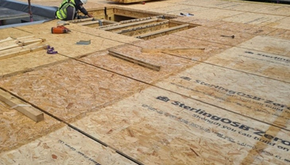
 In recent years, West Fraser has seen a big increase in the use of its SterlingOSB Zero and other products like CaberDek by engineered wood specialists, who cite their outstanding dimensional accuracy, stability and ease of machining as the use of CAD Cam production techniques eclipse traditional bench skills. 


What is now a hybrid supply chain is not only delivering open and closed panel timber frames along with SIPs and cassettes or sectionalised loft structures, but there is also a boom in bespoke solutions featuring smaller components.  The trees growing today across the forests of the Northern Hemisphere may still closely resemble the genotype of species which covered the landscape centuries ago, but the uses to which they are being put bears little resemblance to the timber framed homes of Tudor times or even 20th century construction.  There is a whole new world of engineered wood.   https://uk.westfraser.com

The reconstruction of a rambling old farmyard close to Ely in East Cambridgeshire is making use of well proven Marmox Thermoblocks, specified in three widths as the ideal solution for tackling thermal-bridging around the building perimeter as part of a well-insulated design. Mitchell’s Barn is replacing a sprawling complex of dilapidated tin cowsheds and a rather more attractive oak barn which was founded on a plinth of Tudor era bricks.


Construction site with a concrete foundation, a lone tree, and vehicles. Worker stands near building blocks. Overcast sky and open field.

The original planning permission allowed for the reconstruction of the latter structure, but when the owner, Ben Hughes came to dismantle the outer envelope, much of the timber was found to be rotten while the bricks showed significant frost-damage. The work which got under way earlier in the autumn, is therefore seeing both 215mm and 140mm wide Thermoblocks being used to support a 800mm high brick base which will then carry the conserved oak beams, creating a traditional looking inner ambience.


Ben Hughes commented: “I have taken responsibility for the design as well as the construction of what will be a four-bedroom, three-bathroom property, as a self-build project with the help of a builder, Peter Axton who I have worked with on previous projects. As it is such an exposed site, the house takes the form of a three-sided courtyard which will shelter the south facing terrace. Primarily a Class Q conversion of an agricultural building into a residential building, the new structure is all single storey, but with a mezzanine to accommodate the plant and services that will include an air source heat pump and MVHR system."


"Essentially, we are rebuilding it at the same scale using the same traditional techniques as the original, with additional oak for the frame coming from a tree felled on the site. In order to meet Building Regulations, we have gone for an insulated cavity wall with 150m of PIR insulation for the floor and roof, but when I was researching how to address the issue of thermal bridging at the floor wall junction, Marmox Thermoblock seemed to be the only targeted product solution. In terms of the loadings and the insulation values I am certain it will work well. It’s a good mix of old and new technologies and I’m very happy with the design overall.”


In total Ben and his bricklayer have used 144 x 140x65mm blocks plus 18 x 100x65mm blocks and 50 x 215x65mm blocks, purchased from Insulation Shop on-line. Bedded in conventional mortar, the stepped overlaps between adjacent Thermoblocks have been secured using a high performance (Sika) adhesive.


Ben concluded saying: “The work is progressing well and my bricklayer, Danny, has had no issues with laying the Thermoblocks or cutting them where it has been necessary. Some of the packages, such as for the windows, are still to be placed, but I am confident of the finished property exceeding the current Building Regulation requirements and making a very comfortable home.” 


He is also consulting with Marmox’s technical department over the use of the company’s even longer established Multiboard thermal tilebacker board and other products for fitting out the bathrooms, including at least one wetroom. With a proven track record going back more than a decade, Thermoblocks are available in widths of 100, 140 and 215mm and feature a unique design where two rows of high strength epoxy concrete mini-columns are encapsulated in sections of XPS (Extruded polystyrene).


They are attached at either end to the top and bottom layers of glass-fibre reinforced polymer concrete to achieve a strong bond with the rest of the structure. As well as being used in basement construction and around the floor-wall junction – supporting timber frame as well as masonry walls – Thermoblocks regularly feature at first floor level and beneath parapet walls. They are further employed for swimming pool construction. www.marmox.co.uk

bottom of page