top of page

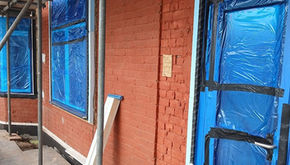
ISO-Chemie’s thermal insulating and load bearing bracket support system has been specified to provide energy efficiency improvements to an Edwardian property in Oxfordshire. The move sees WINFRAMER units retrofitted as part of an initiative to bring the poorly insulated solid walled house built in 1909 in Oxford, up to current energy efficiency standards, providing better quality accommodation for the homeowner along with long-term cost savings.


Red brick building under construction. Blue plastic covers windows and door. Scaffolding present. Emphasis on renovation work.

Passivhaus certified and fire rated to up to 30 minutes, WINFRAMER is a prefabricated installation frame, manufactured to accommodate cavities up to 250mm that allows windows to be supported independently from the face of the wall regardless of any external cladding being in place.


Quick and easy to install, the product’s application in Oxford is seen as part of a solution to meet a wider Government strategy to reduce carbon levels in housing that has single skin walls or non-cavity walls - these buildings have a reputation for leaking considerable amounts of energy, heat and sound.


Nikki Lambert of development contractor Lambert Home Builds, said the project was a whole house retrofit and added: “Using the WINFRAMER system is a game changer for us as the existing windows are being replaced with new high performance triple glazing. They are then moved into the external wall insulation system, where it’s integral to have a secure fixing system as well as a means to mitigate thermal bridging.”


Red brick wall with a large glass window, framed by a light-colored trim. A small plaque with text is visible above the wall.


Andy Swift, ISO-Chemie’s sales and operations manager – UK and ROI, added: “Using WINFRAMER as a platform for the windows to be moved forward, allows a cavity wall to be created outside the existing one. This can then be filled with insulation to massively improve thermal efficiency. As it’s thermally efficient and airtight, WINFRAMER is proving to be an easy and cost-effective way to improve the quality of properties.”


The composite WINFRAMER brackets can bear heavy window loads, including bi-fold doors, to provide a reliable, strong and high-performance support frame. Installation is quick with windows attached directly and secured mechanically using either standard fixing screws or fixing lugs in the usual manner.


A hinged insulation core combines with the composite structural bracket to become an integral part of the overall wall structure, providing compliance with Building Energy Act requirements and the RAL quality assurance association.


ISO-Chemie is one of Europe’s main producers of impregnated foam sealants, specialising in the manufacture of foam products from polyethylene (EPE), polypropylene (EPP) and polyurethane (PUR) using the latest production techniques.

The reconstruction of a rambling old farmyard close to Ely in East Cambridgeshire is making use of well proven Marmox Thermoblocks, specified in three widths as the ideal solution for tackling thermal-bridging around the building perimeter as part of a well-insulated design. Mitchell’s Barn is replacing a sprawling complex of dilapidated tin cowsheds and a rather more attractive oak barn which was founded on a plinth of Tudor era bricks.


Construction site with a concrete foundation, a lone tree, and vehicles. Worker stands near building blocks. Overcast sky and open field.

The original planning permission allowed for the reconstruction of the latter structure, but when the owner, Ben Hughes came to dismantle the outer envelope, much of the timber was found to be rotten while the bricks showed significant frost-damage. The work which got under way earlier in the autumn, is therefore seeing both 215mm and 140mm wide Thermoblocks being used to support a 800mm high brick base which will then carry the conserved oak beams, creating a traditional looking inner ambience.


Ben Hughes commented: “I have taken responsibility for the design as well as the construction of what will be a four-bedroom, three-bathroom property, as a self-build project with the help of a builder, Peter Axton who I have worked with on previous projects. As it is such an exposed site, the house takes the form of a three-sided courtyard which will shelter the south facing terrace. Primarily a Class Q conversion of an agricultural building into a residential building, the new structure is all single storey, but with a mezzanine to accommodate the plant and services that will include an air source heat pump and MVHR system."


"Essentially, we are rebuilding it at the same scale using the same traditional techniques as the original, with additional oak for the frame coming from a tree felled on the site. In order to meet Building Regulations, we have gone for an insulated cavity wall with 150m of PIR insulation for the floor and roof, but when I was researching how to address the issue of thermal bridging at the floor wall junction, Marmox Thermoblock seemed to be the only targeted product solution. In terms of the loadings and the insulation values I am certain it will work well. It’s a good mix of old and new technologies and I’m very happy with the design overall.”


In total Ben and his bricklayer have used 144 x 140x65mm blocks plus 18 x 100x65mm blocks and 50 x 215x65mm blocks, purchased from Insulation Shop on-line. Bedded in conventional mortar, the stepped overlaps between adjacent Thermoblocks have been secured using a high performance (Sika) adhesive.


Ben concluded saying: “The work is progressing well and my bricklayer, Danny, has had no issues with laying the Thermoblocks or cutting them where it has been necessary. Some of the packages, such as for the windows, are still to be placed, but I am confident of the finished property exceeding the current Building Regulation requirements and making a very comfortable home.” 


He is also consulting with Marmox’s technical department over the use of the company’s even longer established Multiboard thermal tilebacker board and other products for fitting out the bathrooms, including at least one wetroom. With a proven track record going back more than a decade, Thermoblocks are available in widths of 100, 140 and 215mm and feature a unique design where two rows of high strength epoxy concrete mini-columns are encapsulated in sections of XPS (Extruded polystyrene).


They are attached at either end to the top and bottom layers of glass-fibre reinforced polymer concrete to achieve a strong bond with the rest of the structure. As well as being used in basement construction and around the floor-wall junction – supporting timber frame as well as masonry walls – Thermoblocks regularly feature at first floor level and beneath parapet walls. They are further employed for swimming pool construction. www.marmox.co.uk

ISO Chemie’s thermal insulating and load bearing bracket support system has been specified for a new energy saving pilot project being carried out by Cambridge City Council. The move sees WINFRAMER units retrofitted around new windows currently being installed at council owned properties in the Ross Street and Coldham’s Grove area to bring them up to a net zero carbon standard. An insulation layer is also being installed in front of each unit and clad over to significantly reduce heat loss and improve energy efficiency.


City Council Specifies ISO Chemie For Energy Improvement Pilot Project

The improvement works are part of a wider initiative by the council to reduce a third of residential-based carbon dioxide emissions in the city, providing improved housing and wellbeing for homeowners along with long-term cost savings.


As well as reduced energy consumption and emissions, the project aims to deliver a consistent and comfortable indoor temperature throughout the year for tenants, better ventilation and indoor air quality with no damp or draughts, together with attractive homes in a state of good repair.


Passivhaus certified and fire rated to up to 30 minutes, WINFRAMER is a prefabricated installation frame, manufactured to accommodate cavities up to 250mm that allows windows to be supported independently from the face of the wall regardless of any external cladding being in place. Quick and easy to install, the product can be integrated alongside other systems to achieve Passivhaus certified window perimeter sealing performance.


The Cambridge project comes as the Government’s strategy continues to push to reduce carbon levels in housing that has single skin, cavity or non-cavity walls - these properties have a reputation for losing considerable amounts of energy, heat and sound. The ISO Chemie products are expected to deliver improved levels of air tightness and thermal performance across the properties when the work is completed in July 2025.

City Council Specifies ISO Chemie For Energy Improvement Pilot Project


The WINFRAMER together with the windows are being installed by Lincolnshire-based manufacturers and suppliers of windows, doors and conservatories, Synerjy Ltd. The company’s managing director said Cambridge City Council’s sustainability strategy outlines a roadmap that leads to its housing stock achieving net zero carbon emissions by 2030.


He added: “With the sustainability programme in mind, we are retrofitting these properties to help the council achieve zero carbon ready standards. This work is scheduled to complete this summer and ISO Chemie’s products will undoubtedly prove their value in delivering long-term beneficial energy efficiency improvements.”


Nick Thompson, ISO Chemie’s technical adviser, said: “As new building regulations continue to take effect, property owners and landlords are increasingly requiring smarter ways to deliver their refurb projects through sustainable technologies. Our products can support this activity, providing high performance airtight, acoustic and thermal sealing solutions.


The composite WINFRAMER brackets can bear heavy window loads, including bi-fold doors, to provide a reliable, strong and high-performance support frame. Installation is quick with windows attached directly and secured mechanically using either standard fixing screws or fixing lugs in the usual manner. A hinged insulation core combines with the composite structural bracket to become an integral part of the overall wall structure, providing compliance with window energy saving regulations (EnEV) and the RAL quality assurance association.  https://www.iso-chemie.eu/en-GB/home/

bottom of page